
Key Legal Issues
The distinction between contested and uncontested divorce centres on whether the parties agree on the terms of their separation, including issues such as property division, child custody and access, child support, and spousal support.
Definitions
Uncontested Divorce:
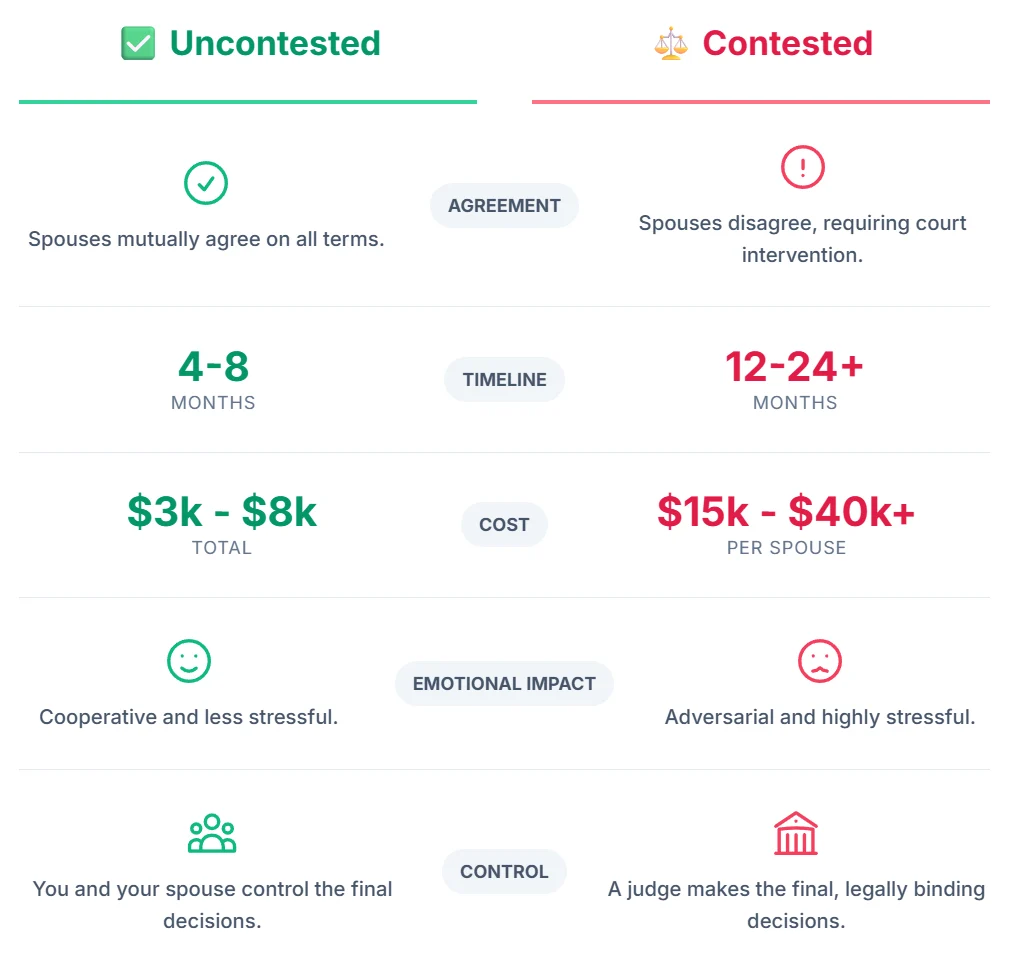
An uncontested divorce occurs when both parties agree on all material issues arising from the breakdown of the marriage, or when one party files for divorce and the other does not respond or oppose the application. In this scenario, the court’s role is largely administrative, and the divorce is granted based on the parties’ agreement and compliance with statutory requirements.
Contested Divorce:
A contested divorce arises when the parties cannot agree on one or more key issues. Disputes may relate to the grounds for divorce, parenting arrangements, support, or property division. The court is required to adjudicate these disputes, and the process may involve case conferences, motions, and potentially a trial.
Application of Legal Principles
Uncontested Divorce:
The court reviews the application to ensure statutory requirements are met (e.g., grounds for divorce, proper arrangements for child support). If satisfied, the divorce is granted without a hearing.
Contested Divorce:
The court may require disclosure, case conferences, mediation, and, if necessary, a trial. The judge will make binding decisions on unresolved issues, guided by the best interests of the child and fairness in property and support matters.
Important Caveats and Limitations
Transition:
A divorce may begin as contested and become uncontested if the parties reach agreement during the process, or vice versa if new disputes arise.
Child-Related Issues:
The court will not grant a divorce unless it is satisfied that reasonable arrangements have been made for the support of any children (Divorce Act, s. 11(1)(b)).
Separation Agreement:
Even in uncontested divorces, a comprehensive separation agreement is advisable to formalize the parties’ arrangements and prevent future disputes.
Practical Considerations
Uncontested divorce is generally preferable where possible, due to reduced cost, time, and emotional strain.
Contested divorce may be necessary where there are significant disagreements or concerns about fairness, safety, or the best interests of children.
Infographic
Relevant Legal Principles and Statutes
- Divorce Act (RSC 1985, c 3 (2nd Supp)): Governs the granting of divorce and related relief in Canada.
- Family Law Act (R.S.O. 1990, c. F.3): Governs property division, support, and related matters in Ontario.
- Ontario Rules of Civil Procedure and Family Law Rules: Set out the procedures for both contested and uncontested divorce applications.
Contested vs Uncontested Divorce: FAQs
It’s when both spouses agree on all issues (custody, support, property). The process is mostly administrative and quicker.
It’s when spouses disagree on one or more issues, requiring court involvement to decide.
Uncontested divorce is faster since it avoids lengthy court hearings.
Contested divorce usually costs more due to lawyer fees, court appearances, and longer timelines.
Yes. If spouses reach an agreement during the process, it can shift to uncontested.
Yes. The court must be satisfied that reasonable support is in place before granting any divorce.
It’s strongly recommended to prevent future disputes, even if both parties agree now.
