
The latest Ontario Superior Court of Justice 2024–2025 Report gives separated spouses and parents a clear message: family law disputes remain a major part of Ontario’s court system.
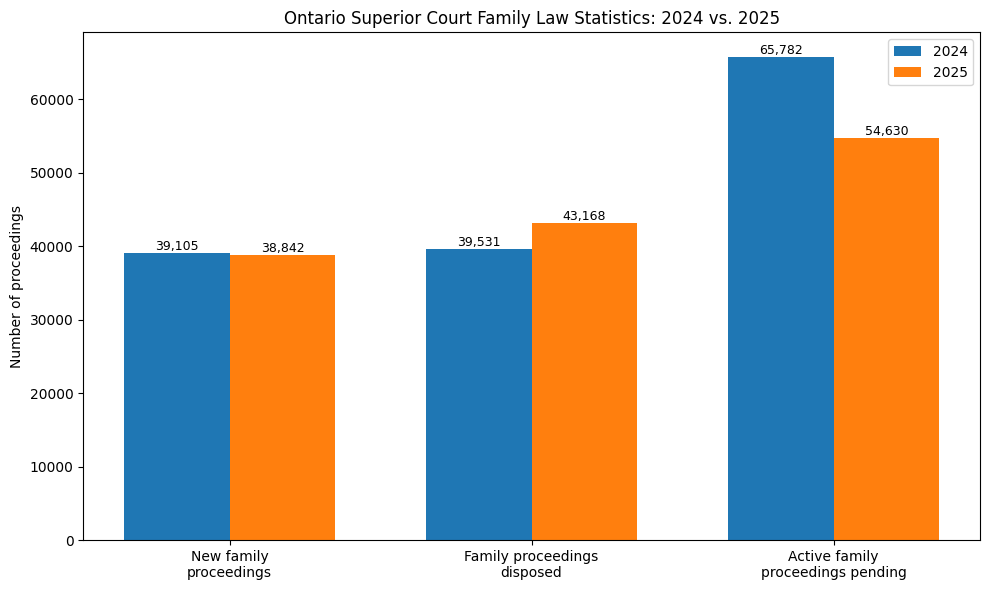
In 2025, the Superior Court of Justice reported 38,842 new family proceedings across Ontario when unified and non-unified family proceedings are combined. These are not just numbers on a chart. Behind every file is a family dealing with difficult decisions about divorce, children, support, property, the matrimonial home, business interests, pensions, domestic safety, or the future structure of their family.
For people going through separation, the court statistics matter because they show how much pressure the system is under. They also show why early legal strategy is so important. A court case is not just about filing documents. It is about knowing what relief to ask for, what evidence is needed, when to bring a motion, when to negotiate, and when trial preparation becomes necessary.
At Progressive Legal Solutions, we focus on family law disputes where court representation, evidence, financial disclosure, parenting issues, and trial strategy matter.
Key Ontario family law court statistics for 2025
The 2025 report separates family matters into two categories:
Non-unified family proceedings are family matters in Superior Court locations where jurisdiction is shared between the Superior Court of Justice and the Ontario Court of Justice.
Unified family proceedings are matters in Family Court Branch locations where all family law issues can generally be dealt with in one court.
When combined, the family law numbers show the following:
| Family law court statistic | 2024 | 2025 | Change |
|---|---|---|---|
| New family proceedings | 39,105 | 38,842 | Down about 0.7% |
| Family proceedings disposed | 39,531 | 43,168 | Up about 9.2% |
| Active family proceedings pending | 65,782 | 54,630 | Down about 17.0% |
At first glance, the decrease in active pending proceedings may look like the family court system is becoming much less crowded. That conclusion would be too simple.
The report explains that Ontario completed a major initiative to dismiss inactive family law cases that were eligible for dismissal. It also notes that court data may be affected by administrative dismissals and data transition issues. In plain language, some of the reduction in pending files likely reflects cleanup of inactive court files, not necessarily a dramatic drop in real family conflict.
For separating spouses and parents, the practical takeaway is this: the court is still handling tens of thousands of new family law cases every year. If your case involves property, support, parenting, a matrimonial home, urgent relief, or trial risk, you need a plan before the file becomes reactive.
What counts as a new family proceeding?
The report notes that new family proceedings include new applications, motions to change a final order, and certain requests filed with the court. It does not include every enforcement proceeding or every fee waiver request.
This is important because a “new proceeding” is not always a brand-new separation. It may involve former spouses returning to court because circumstances changed. For example:
- A parent may ask to change parenting time or decision-making responsibility.
- A spouse may ask to vary child support or spousal support.
- A party may seek relief because financial disclosure was incomplete.
- A parent may bring a motion because the other parent is not following an order.
- A former spouse may return to court because a final order no longer works.
Family law does not always end when an agreement or court order is signed. Parenting schedules, income, employment, business value, children’s needs, relocation plans, and support obligations can change.
Unified family court numbers increased in 2025
The report shows a difference between unified and non-unified family court data.
In non-unified family proceedings, new proceedings decreased from 16,611 in 2024 to 15,789 in 2025.
In unified family proceedings, new proceedings increased from 22,494 in 2024 to 23,053 in 2025.
This matters because many Ontario communities now rely heavily on unified family court. In unified locations, family law cases can be handled in one specialized court, which can make the process easier to navigate compared with split jurisdiction areas.
However, “easier to navigate” does not mean simple. Family Court still requires proper pleadings, disclosure, evidence, conferences, offers, motions, and trial preparation where settlement is not possible.
Central East had the highest reported family law filing volume
For families in the GTA, York Region, Durham Region, Simcoe County, Barrie, Newmarket, and surrounding areas, the Central East numbers are especially important.
The report shows that the Central East Region received 8,654 new unified family proceedings in 2025, up from 8,339 in 2024.
Central East includes court locations such as Newmarket, Barrie, Bracebridge, Cobourg, Durham, Lindsay, and Peterborough. It also has satellite court locations, including Collingwood, Midland, and Orillia.
This is directly relevant to many families in the Greater Toronto Area and Simcoe County. These are fast-growing communities with many families, homes, mortgages, businesses, pensions, and complex parenting arrangements. When separation happens, the legal issues are often financially and emotionally significant.
2025 family filings by Ontario region
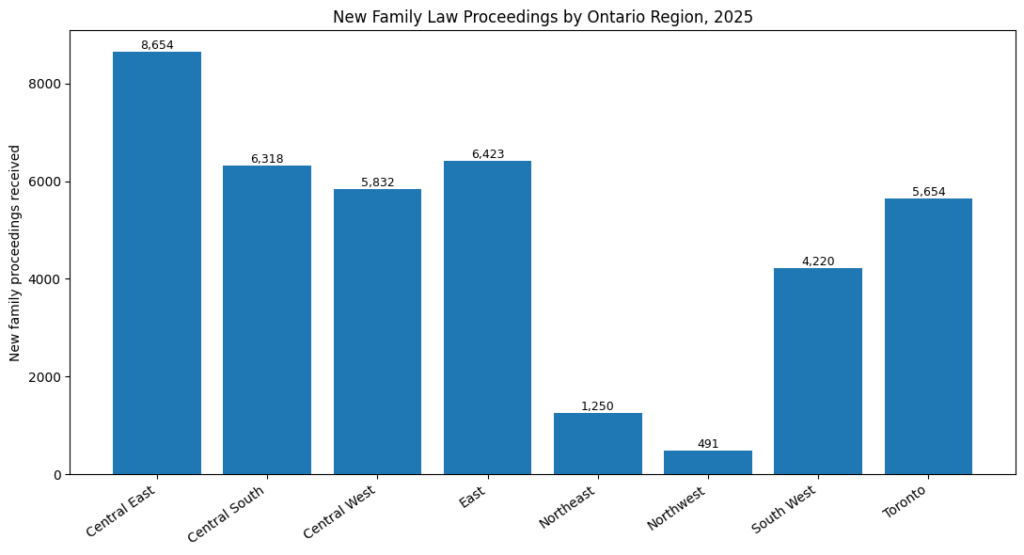
Here is the combined 2025 family proceeding count by region based on the report:
| Region | New family proceedings in 2025 |
| Central East | 8,654 |
| East | 6,423 |
| Central South | 6,318 |
| Central West | 5,832 |
| Toronto | 5,654 |
| South West | 4,220 |
| Northeast | 1,250 |
| Northwest | 491 |
The Toronto number should be read carefully because the report notes possible under-representation of Toronto civil, family, and Small Claims Court data after the October 2025 digital case-management transition.
Even with that caution, the broader picture is clear: family law litigation remains active across the province.
What these statistics mean if you are separating in Ontario
If you are thinking about separation or already dealing with a court case, the numbers point to several practical lessons.
1. Court strategy should start early
Many people wait too long before getting advice. They try to negotiate informally, exchange incomplete information, or respond emotionally to conflict. By the time they speak to a lawyer, the other party may already have filed an Application, brought an urgent motion, or taken a position that affects parenting, property, or support.
Early advice helps you understand:
- What court can and cannot do.
- What evidence you need.
- Whether your matter belongs in court, mediation, negotiation, or arbitration.
- Whether urgent relief is realistic.
- What financial disclosure is required.
- How to avoid making statements or agreements that hurt your position later.
2. Motions remain a major part of family court
The report’s event data shows that motions are a major part of family court activity. A motion is often used when a party needs temporary or urgent relief before trial.
Common family law motions include requests for:
- Interim parenting time.
- Decision-making responsibility.
- Child support.
- Spousal support.
- Exclusive possession of the matrimonial home.
- Disclosure orders.
- Restraining orders.
- Sale of the home.
- Preservation of property.
- Enforcement of existing orders.
A motion can shape the direction of the case. The evidence filed on a motion may also influence negotiations and future court conferences. That is why affidavit drafting, financial documents, exhibits, and legal argument need to be prepared carefully.
3. Property division cases need strong financial disclosure
The Superior Court has jurisdiction over divorce, family property, and matrimonial home issues. For spouses with a home, pensions, investments, corporations, professional practices, rental properties, debts, or inheritances, the numbers can become complex.
In many separations, the real dispute is not whether the parties should separate. The real dispute is financial:
- What is the value of the matrimonial home?
- Should the home be sold?
- Who stays in the home while the case is ongoing?
- What is each spouse’s date-of-separation property?
- Are there excluded assets?
- Is one spouse hiding income or assets?
- Should a business be valued?
- How should pensions be treated?
- Is there a support claim?
- What is the proper income for support purposes?
Court representation becomes especially important when the other side refuses disclosure, takes unreasonable positions, or uses delay as leverage.
4. Parenting cases require evidence, not assumptions
Parenting disputes are often emotionally difficult. However, court decisions are not based on who feels more strongly. They are based on the best interests of the child and the evidence presented.
In parenting litigation, the court may look at:
- The child’s needs.
- The history of caregiving.
- Each parent’s involvement.
- School, daycare, medical, and extracurricular arrangements.
- Communication between the parents.
- Family violence concerns.
- Mental health or addiction issues where relevant.
- The child’s stability.
- Whether a parenting plan is practical and child-focused.
A strong parenting case is not built by attacking the other parent. It is built by showing a practical, child-focused plan supported by evidence.
5. Trial preparation should not wait until the trial date
Many family law cases settle before trial. However, the strongest settlement position often comes from being prepared for trial.
Trial preparation may involve:
- Organizing the evidentiary record.
- Reviewing pleadings, conference briefs, offers to settle, and prior orders.
- Identifying the legal issues that remain unresolved.
- Preparing witnesses.
- Creating a document brief.
- Reviewing financial statements and disclosure.
- Preparing opening statements and examination questions.
- Considering settlement exposure.
- Making or responding to offers to settle.
When trial preparation starts too late, the case can become expensive and stressful very quickly. If your matter is already in court and a trial is approaching, getting a trial-focused legal assessment can help identify the strengths, weaknesses, evidence gaps, and strategic steps that still remain.
Why court representation matters in high-conflict divorce
Some separations can be resolved with limited legal assistance. Others cannot.
Court representation is especially important where there is:
- Refusal to provide financial disclosure.
- A dispute over the matrimonial home.
- Business ownership or self-employment income.
- High income or complex compensation.
- Significant assets, pensions, investments, or debts.
- Parenting conflict.
- Relocation issues.
- Family violence or urgent safety concerns.
- Repeated breach of agreements or orders.
- Trial risk.
- A spouse who is using delay or pressure as a strategy.
In these cases, the right legal strategy can make a meaningful difference. The goal is not to fight for the sake of fighting. The goal is to move the case toward a practical, legally sound resolution while protecting your position.
What to do before starting a family court case
Before starting or responding to a court case, consider the following steps:
- Collect your financial documents, including tax returns, notices of assessment, paystubs, bank statements, mortgage documents, pension statements, business records, and debt statements.
- Write a clear timeline of separation, parenting arrangements, major financial events, and important communications.
- Keep communication with the other party respectful and in writing where possible.
- Do not move money, sell property, or make major parenting changes without legal advice.
- Get advice before signing any agreement.
- If you receive court documents, do not ignore deadlines.
- If trial is approaching, request a focused review of your evidence, offers, and court materials.
FAQ
The Ontario Superior Court of Justice reported 38,842 new family proceedings in 2025 when unified and non-unified family proceedings are combined.
The total number of new Superior Court family proceedings was slightly lower in 2025 than in 2024. However, unified family court proceedings increased, and the family court system still handled tens of thousands of new cases. The numbers should also be read with caution because the report notes data and administrative-dismissal issues.
In unified family court locations, most family law issues can be handled in one court. In non-unified locations, jurisdiction may be split between the Superior Court of Justice and the Ontario Court of Justice, depending on the issue.
The Superior Court of Justice handles divorce, family property, and matrimonial home issues in Ontario.
Common reasons include divorce, parenting time, decision-making responsibility, child support, spousal support, property division, matrimonial home disputes, urgent motions, disclosure disputes, and enforcement or variation of existing orders.
Many family law cases settle before trial, but trial preparation is still important. A case that is organized, well-supported by evidence, and ready for trial is usually in a stronger position for both negotiation and court.
You should speak with a family lawyer as early as possible if your matter involves children, support, property, the matrimonial home, business assets, urgent issues, financial disclosure problems, or a scheduled court appearance.
Bring court documents, agreements, financial disclosure, tax documents, pay information, mortgage or property records, pension information, important emails or texts, and a timeline of key events.
How Progressive Legal Solutions can help
Progressive Legal Solutions represents clients in Ontario family law matters involving separation, divorce, parenting, child support, spousal support, property division, matrimonial home issues, motions, and trials.
We assist clients who need serious court representation, including high-conflict and complex family law disputes. Whether your matter is just starting or already in court, the right strategy can help you understand your options, protect your position, and move forward with greater confidence.
If you are separating, already in family court, or preparing for trial, contact Progressive Legal Solutions to book a consultation.
Disclaimer: This article is for general information only and is not legal advice. Family law outcomes depend on the specific facts, evidence, court location, legal issues, and procedural history of each case. Speak with a family lawyer before making decisions about your matter.
